
Have you ever woken up after seven or eight hours of deep sleep feeling as if you haven’t rested at all? You step out of bed, your limbs feel weighed down like lead, your tongue has a sticky white film, and by late afternoon, your stomach balloons so uncomfortably that loosening your belt is the only relief.
When you get blood work, ultrasounds, or an endoscopy done, the reports often return “completely normal.” Yet, your daily lived reality tells a contrasting story: unprovoked bloating, sour belching, unpredictable stools, and a chronic lack of genuine hunger.
In contemporary wellness discussions, this is routinely labeled as “sluggish gut flora” or “IBS.” In classical Ayurveda, our diagnostic lens looks at an earlier stage of cellular disruption: Manda Agni (depleted digestive fire) leading to the accumulation of Ama (undigested, toxic metabolic residue).
Key Takeaway Snapshot: The Agni-Ama Axis
| Clinical Parameter | Balanced State (Sama Agni) | Toxin-Overloaded State (Manda Agni + Ama) |
| Morning Hunger | Sharp, clear appetite within 1 hour of waking | Complete absence of hunger; nausea at the thought of breakfast |
| Tongue Coating | Clean, pink, translucent saliva film | Thick white/yellow sticky coating (Jihwa Lepa), especially at the base |
| Bowel Evacuation | Effortless, floats or breaks cleanly, odorless | Sticky stool that clings to ceramic, foul smell, incomplete evacuation feeling |
| Afternoon Energy | Sustained alertness post-meals | Debilitating drowsiness, brain fog, and heavy limbs |
| Joint & Body Feel | Light, nimble, supple movement | Stiffness upon waking, unexplained dull aches across small joints |
What Actually Is “Ama”? (Beyond the Generic Word “Toxins”)
Mainstream health articles use the word “detox” haphazardly, usually to sell cold-pressed green juices or laxative powders. But in genuine Ayurvedic pathology (Samprapti), Ama has a precise physical and functional definition.
Think of your stomach and intestines as an internal kitchen. Your digestive fire—Jatharagni—is the flame underneath the cooking pot.
-
- When the flame burns bright and steady, whatever you feed it transforms into clean cellular nutrition (Ahara Rasa), nourishing your blood, muscle, and immunity.
-
- When that flame flickers or smothers due to overeating, erratic schedules, ice-cold drinks, or chronic stress, food sits in your gastrointestinal tract half-cooked.
Instead of nourishing you, this half-processed slurry ferments, turns foul, and creates a dense, sticky, non-homogenized waste known as Ama.
Because of its heavy (Guru), sticky (Snigdha), and cold (Sheeta) properties, Ama slowly coats the micro-channels (Srotas) of your intestines. It physically obstructs nutrient absorption while circulating endotoxins into peripheral tissues. This is why standard pathology panels rarely identify the cause: Ama begins as a functional metabolic malfunction long before it manifests as structural tissue damage detectable on a scan.
7 Unmistakable Signals Your Gut Is Harboring Ama
If your system is carrying metabolic sludge, your body sends overt daily signals rather than subtle hints.
1. Aruchi (The Absence of “True Hunger”)
True hunger (Kshudha) feels crisp, pleasant, and makes simple warm food appetizing. If you eat merely because the clock says 1:30 PM, or if the idea of plain warm khichdi repulses you while ultra-spicy snacks tempt you, your Agni is compromised.
2. Jihwa Mala (The White-Coated Tongue)
Look in the mirror first thing in the morning. A thick, whitish-grey layer across the middle and rear third of your tongue is a direct mirror of your colon and small intestine. If scraping it off requires aggressive effort and it re-accumulates by evening, Ama is actively generating in your GI tract.
3. Gaurava (Unshakeable Heaviness in the Limbs)
That sensation where walking up a flight of stairs or simply getting off the sofa feels like dragging wet sandbags. This systemic lethargy is the physical weight of circulating endotoxins.
4. Aalasya & Tandra (Post-Meal Brain Fog & Coma)
Do you feel an irresistible urge to lie down immediately after a standard home-cooked lunch? When Agni is smothered, the body diverts all its vital prana to the gut simply to churn the undigested load, leaving your mind sluggish, unfocused, and drowsy.
5. Picchila Mala (Sticky, Sinking Stools)
Stool should ideally pass in one clean movement within twenty minutes of waking, floating effortlessly in the bowl without staining the ceramic. If you need half a roll of toilet paper, or if small, broken pieces leave a persistent sensation of unfinished evacuation, your waste is bound with sticky Ama.
6. Vibandha & Anaha (Trapped Gas & Abdominal Distension)
Unlike temporary gas caused by eating legumes, Ama-induced bloating causes a firm, tympanic abdomen that stays distended for hours, accompanied by foul-smelling flatulence.
7. Klama (Exhaustion Without Physical Exertion)
You haven’t run a marathon or lifted heavy weights, yet your body feels deeply fatigued. This occurs because the micro-channels supplying nutrition to the bodily tissues (Dhatus) are mechanically clogged by micro-Ama.
The Fatal Mistake: Jumping Straight to “Aggressive Cleanses”
When modern health seekers realize their gut is congested, the instinctive reaction is often catastrophic: they start drinking raw kale smoothies, downing large doses of triphala, or undertaking intense water fasts.
Classical Ayurvedic treatises (Charaka Samhita) warn explicitly against this mistake.
If you try to forcefully expel deep-seated Ama while your digestive fire is still cold and damp, you end up doing what classical texts describe as squeezing juice from an unripe fruit: you destroy the vessel without clearing the obstruction.
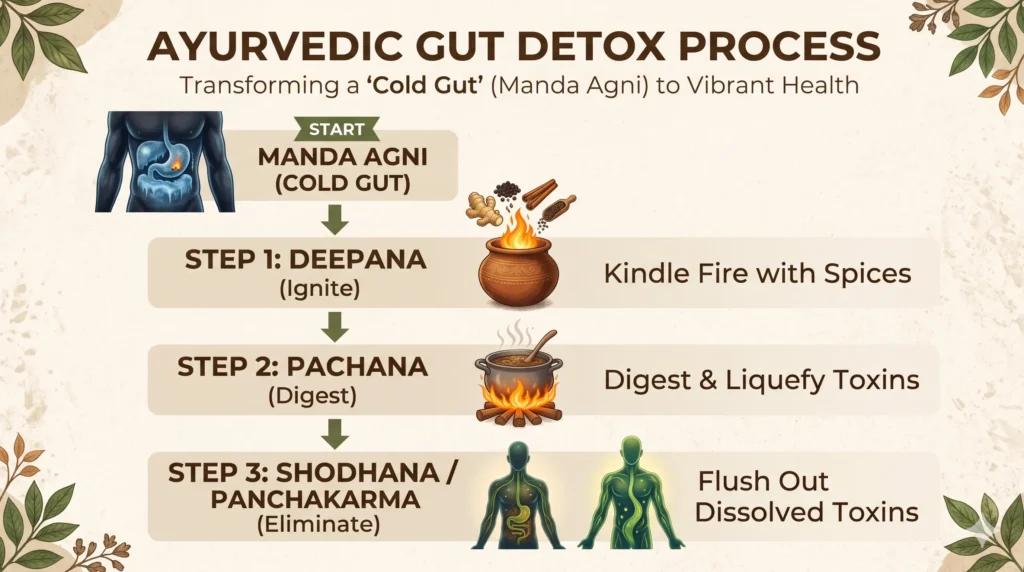
To clear gut toxins sustainably, you must follow the ancient clinical sequence: Deepana (Kindling), Pachana (Digesting the toxins), and only then Shodhana (Elimination).
The 3-Step Protocol to Kindle Agni & Melt Ama
Restoring your digestive system does not require exotic imports. It starts with specific thermal and dietary adjustments at home.
Phase 1: Deepana & Pachana (The Kitchen Medicine Approach)
Before attempting any deep bowel cleanses, you must heat the internal system so Ama breaks down from a thick gel into a liquid state:
-
- The Fresh Ginger Aperitif (Ardraka Khanda): Ten minutes before lunch and dinner, chew a thin slice of fresh ginger sprinkled with two drops of fresh lime juice and a tiny pinch of rock salt (Saindhava Lavana). Ginger activates saliva and gastric secretions; rock salt kindles Agni without aggravating Pitta; lime stimulates digestive enzymes.
-
- Ushnodaka (The Boiled Warm Water Protocol): Stop drinking room-temperature and refrigerated water entirely. Boil plain water for 10 minutes until reduced by roughly one-quarter, and sip it hot from a thermos throughout the day. Boiled hot water is light (Laghu), penetrates clogged tissue spaces, and actively dissolves Ama like hot water washing grease off an oily skillet.
-
- CCF Infusion (Cumin, Coriander, Fennel): Boil 1/2 teaspoon each of whole jeera, dhaniya seeds, and saunf in 1 liter of water for 5 minutes. Strain and sip warm between meals. Jeera ignites Agni, Coriander cools systemic inflammation, and Fennel relaxes smooth gut muscle spasms.
Phase 2: Targeted Dietary Resets (Langhana)
The most effective way to eliminate toxins is to stop supplying fresh fuel to an overwhelmed fire. For 3 to 5 days, pivot entirely to light, easily assimilable nourishment:
| Meal Time | Therapeutic Option | Clinical Purpose |
| Breakfast | Stewed apples with a clove and pinch of cinnamon, OR warm water only | Gives the nocturnal detox cycle time to finish without burdening the stomach |
| Lunch | Split yellow moong dal khichdi cooked soft with cow’s ghee, ginger, cumin, and turmeric | Provides complete plant protein with near-zero digestive friction |
| Dinner | Warm vegetable soup (bottle gourd / lauki, pumpkin, zucchini) with black pepper | Prevents evening glucose spikes and ensures the gut rests overnight |
Avoid dairy (especially cold milk, paneer, and aged cheeses), refined flour (maida), fried snacks, and raw salads during this period. Raw food requires immense Agni to break down; feeding raw salads to an Ama-burdened gut simply ferments it further.
When Home Remedies Aren’t Enough: Clinical Pulse Diagnosis
Home routines work wonders for daily seasonal accumulations. However, if your bloating, joint stiffness, chronic skin eruptions, or bowel irregularities have persisted for months or years, the Ama has likely migrated out of the digestive tract and lodged into deeper tissues (Dhatu-gata Ama).
At this stage, generic internet protocols become insufficient. Every individual possesses a distinct doshic baseline (Vata, Pitta, or Kapha). For instance:
-
- A person with Vata-dominant Ama suffers from severe dryness, spastic constipation, and sharp gas pains.
-
- A person with Pitta-dominant Ama experiences acid reflux, sour belching, skin breakouts, and loose burning stools.
-
- A person with Kapha-dominant Ama suffers from heavy water retention, profound lethargy, and dense mucous in the stool.
This is where the ancient clinical science of Nadi Pariksha (Ayurvedic Pulse Diagnosis) becomes indispensable. By assessing the three distinct levels of the radial pulse, an experienced Ayurvedic physician reads the subtle frequency of your internal organs, accurately identifying the exact organ system holding metabolic toxins, measuring cellular inflammation, and locating the source of your digestive sluggishness.
When deep-seated metabolic toxins refuse to move with diet alone, structured classical therapies under expert observation—such as specialized internal oleation followed by targeted Ayurvedic Panchakarma Treatments—systematically dislodge Ama from peripheral cells and flush it completely out of the body through the nearest physiological pathways.
Final Thoughts: Listen to Your Internal Flame
Your digestive fire is the ultimate guardian of your vitality, clarity, and immunity. Healing your gut is not about chasing the next restrictive wellness trend or popping over-the-counter antacids every time your stomach burns.
Start by listening to your body’s early warnings. Observe your tongue, respect your genuine hunger, hydrate with warm water, and give your digestion the therapeutic breathing room it needs to self-correct. When guided with patience, warmth, and the timeless principles of classical Ayurveda, a troubled gut can always return to lasting balance.