
45+ Years of Experience · Written by Vaidya Dhyan Prakash Tripathi (Ayurvedacharya)
This article is written from my 45 years of clinical experience and knowledge drawn from classical Ayurvedic texts (Charaka Samhita, Sushruta Samhita). It is not a substitute for professional medical advice — please consult a qualified Vaidya for your specific health condition.
In my 45 years as a practicing Vaidya, I have seen thousands of patients — and one truth holds again and again: until the root cause is healed, any treatment only offers temporary relief.
In today’s world, people are constantly dealing with fatigue, bloating, acidity, and chronic illnesses. Without realizing it, we accumulate toxins in our bodies every day, leaving our entire system sluggish. Modern science calls these “lifestyle disorders.” Ayurveda understood this thousands of years ago — and it also offered the solution, in the form of three strong pillars:
- Panchakarma — Detoxification
- Ahara — Personalized Nutrition
- Vihara — Lifestyle Alignment
Today, drawing on my clinical experience, I will walk you through these three pillars so you can understand how true healing actually works.
1. Ayurvedic Panchakarma: A Complete Reset for the Body
In my clinical practice, Panchakarma is the deepest and most effective detox treatment I have come across. It is not a superficial cleanse — it reaches the body’s most subtle cells and tissues, removes deeply lodged old toxins, known in Ayurveda as “Ama,” and restores the natural balance of the three Doshas — Vata, Pitta, and Kapha.
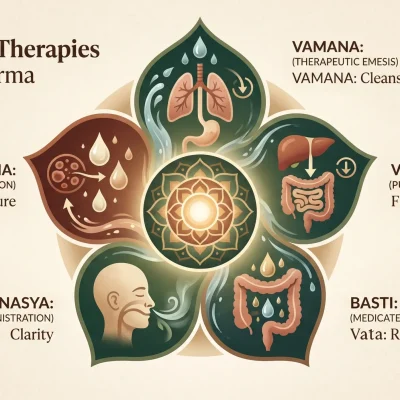
Panchakarma, in Sanskrit, means “Five Actions.” It consists of five therapeutic procedures:
Vamana (Therapeutic Emesis)
When Kapha Dosha becomes excessive in the body — as seen in chronic cough, asthma, or certain skin conditions — controlled, medicated vomiting is induced to expel the excess Kapha toxins.
Virechana (Medicated Purgation)
This is the most effective process for cleansing the liver and gallbladder, and for removing Pitta-related toxins such as acidity, skin rashes, and hyperacidity.
Basti (Medicated Enema)
In my practice, I’ve seen exactly why this is called “the Mother of all Treatments.” It is remarkably effective at treating chronic Vata disorders — such as joint pain, constipation, and neurological issues — at their root.
Nasya (Nasal Administration)
Medicated oils are administered through the nostrils, significantly improving respiratory tract, sinus, and brain health. I have seen good results with this in patients suffering from migraines and sinusitis.
Raktamokshana (Blood Purification)
This is a traditional bloodletting method. Today, we often perform it through safer, modern alternatives, always under qualified supervision.
A Vaidya’s Advice: Panchakarma should never be self-administered. It must be carried out under the supervision of a qualified, Ayurvedacharya, since every procedure requires proper assessment and correct dosage.
In my experience, regular and correctly-administered Panchakarma brings significant relief from chronic diseases, improves metabolism, and gives the body a genuine “reset” that medication alone cannot achieve.
2. Ayurvedic Ahara (Diet): Awaken Your Digestive Fire
“You are not just what you eat — you are what you digest.”
This is a principle I learned from my own guru, and it holds just as true today as it did centuries ago. In Ayurveda, food is regarded as the first medicine — but there is no generic, “one-size-fits-all” diet chart here.
Every individual’s Prakriti (body constitution) is different. Someone may be Vata-dominant, another Pitta, another Kapha — and their diet should be tailored accordingly.
Strengthening the Agni
Our primary goal is to strengthen your digestive fire, known as Agni, so that food digests properly and new Ama (toxins) doesn’t form. It is precisely when the Agni is weak that undigested food turns into toxins, which later becomes the root of disease.
Personalized Nutrition
In my clinical practice, I assess each patient’s Prakriti and current health condition to advise them on:
- Which foods will nourish them
- Which foods may disturb their Dosha
- The right timing and combinations for eating
This approach is far more effective than generic diet plans, because it is designed specifically for your unique body.
3. Ayurvedic Vihara (Lifestyle): Aligning with Nature
Your daily routine — even the smallest habits — has a profound effect on your long-term health. Ayurveda emphasizes two types of routines here:
Dinacharya (Daily Routine)
Setting a proper, consistent schedule from waking up in the morning to going to sleep at night. This includes:
- Sleeping and waking at the right time (waking during Brahma Muhurta is ideal)
- Regular exercise or yoga
- Daily meditation or pranayama
Ritucharya (Seasonal Routine)
Adjusting your lifestyle and diet with the changing seasons. For example, cooling foods in summer and warming foods in winter — to help protect against seasonal allergies, infections, and immunity-related issues.
In my 45 years of experience, patients who seriously followed Dinacharya and Ritucharya showed noticeably better overall immunity and resilience compared to others.
Why These Three Pillars Work Together
Panchakarma, Ahara, and Vihara are not three separate treatments. They are three connected parts of a single healing system:
| Pillar | What It Does | Result |
|---|---|---|
| Panchakarma | Removes old, accumulated toxins (Ama) | A deep reset for the body |
| Ahara | Prevents new toxins from forming | Strong digestion (Agni) |
| Vihara | Aligns the body with nature’s rhythm | Long-term balance and immunity |
Following just one pillar while ignoring the others — such as getting a detox done and then returning to the same unhealthy lifestyle — only produces temporary results. True, lasting healing happens only when all three move forward together.
Frequently Asked Questions
What precautions should be taken before undergoing Panchakarma? Before Panchakarma, there is a preparatory phase called “Purvakarma,” which includes Snehana (oil massage) and Swedana (steam therapy). This should always be done under the supervision of a qualified Vaidya, after sharing your complete health history.
Does following an Ayurvedic diet mean giving up everything? No. Ayurvedic Ahara is not a restrictive diet — it is personalized guidance based on your Prakriti. The goal is to support your Agni, not to eliminate everything.
How long does it take to see results from Panchakarma? This depends on the condition and individual Prakriti. Some patients feel a difference after just one session, while chronic conditions require multiple sessions along with consistent Ahara-Vihara follow-up.
Is Panchakarma safe for everyone? When performed under the supervision of a qualified, Ayurvedacharya, Panchakarma is generally safe. However, procedures are modified or avoided for pregnancy, certain chronic conditions, or weaker patients — which is why a proper consultation is essential.
Begin Your Healing Journey Today
Stop chasing chemical-based shortcuts. Align your lifestyle naturally with Ayurveda’s three pillars:
✅ Purify the body with Panchakarma
✅ Nourish it the right way with Ahara
✅ Maintain daily balance with Vihara
Would you like a customized healing plan based on your own body type (Prakriti)?
Consult our Ayurvedic experts today and take your first step toward deep, lasting healing.
Book a Consultation with Vaidya Ji →
Disclaimer: This content is for educational purposes and is based on classical Ayurvedic principles and clinical experience. It is not a substitute for professional medical diagnosis or treatment. Please consult a registered, CCIM-certified Ayurvedic practitioner before starting any Panchakarma therapy or new diet plan.