Why Ayurveda Stands Apart From Allopathy & Homeopathy
A research-backed, honest comparison — plus what COVID-19 trials taught us about India's 5,000-year-old healing system.
This content is based on peer-reviewed studies, WHO reports, government-verified data, and published clinical trials. It does not substitute professional medical advice.
Choosing a healthcare system is one of the most personal decisions you can make. Across India and increasingly worldwide, millions are asking a fundamental question: should I trust the ancient wisdom of Ayurveda, the precision of modern allopathy, or the energy-based principles of homeopathy?
This guide doesn't preach — it presents facts. We've pulled from clinical trials, WHO strategy documents, market surveys, and published COVID-19 studies to give you the most current, evidence-grounded comparison available in 2026.
"The principles and practice of Ayurveda are especially relevant in the context of the global shift toward non-communicable diseases, largely driven by modifiable risk factors such as unhealthy diets, physical inactivity, and stress."
— UN News / WHO Traditional Medicine Expert, December 2025Global Ayurveda Boom: What the Numbers Say
The market tells a story that neither culture nor tradition alone can explain. Consumer confidence in Ayurveda has reached historic highs:
North America led the Ayurveda market in 2024, holding over 37.8% market share with revenues of USD 6.9 billion, driven by rising awareness of natural healthcare solutions. According to WHO's Traditional Medicine Strategy 2025, more than 170 countries now recognize the use of traditional medicine, and Ayurvedic formulations account for 22% of exported Indian traditional medicines.
Head-to-Head: Ayurveda vs Allopathy vs Homeopathy
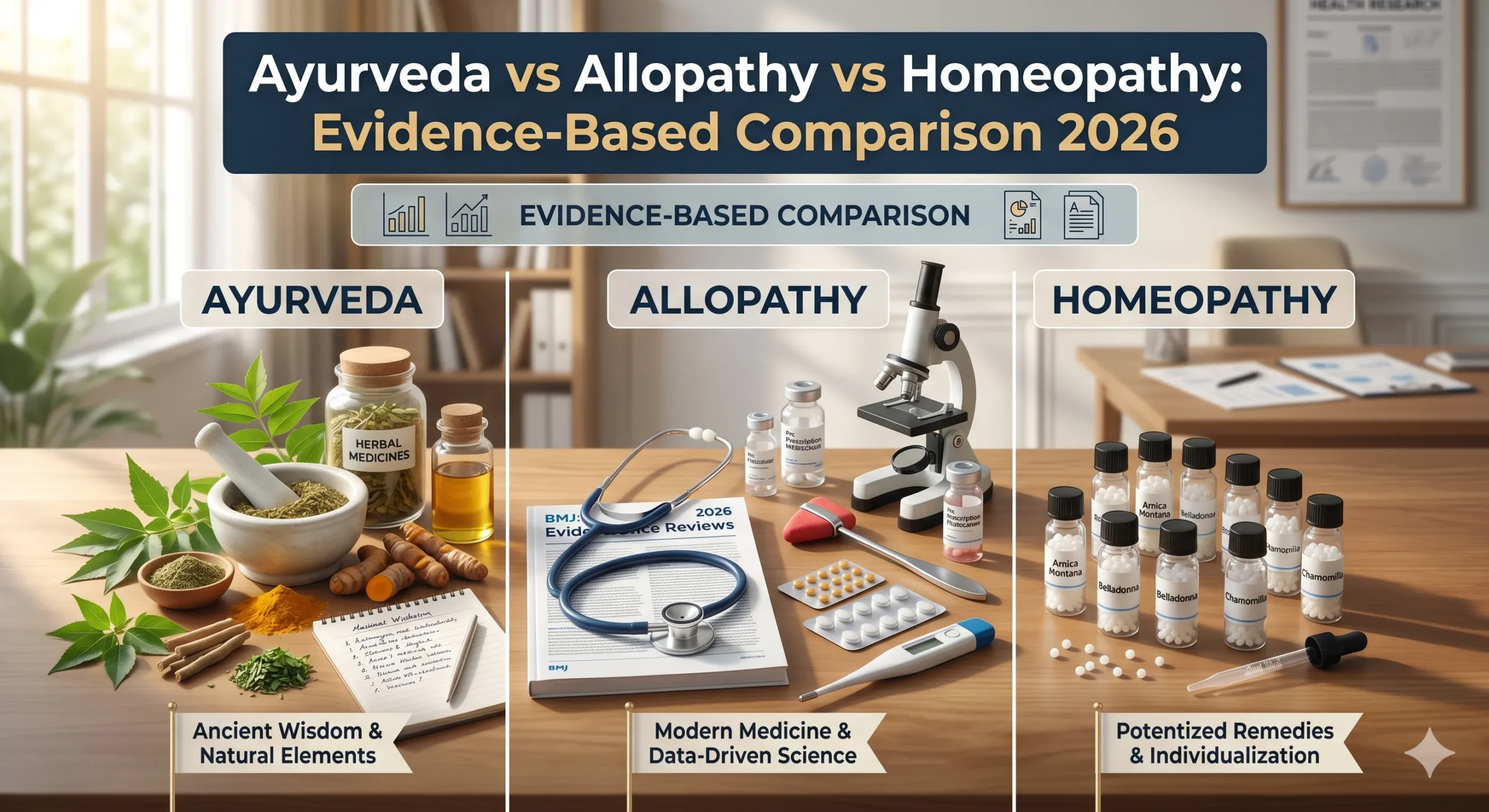
Based on the framework in the image above and supported by peer-reviewed evidence, here is how the three systems compare across the dimensions that matter most to patients:
| Feature | 🌿 Ayurveda | 💊 Allopathy | 🔵 Homeopathy |
|---|---|---|---|
| Core Philosophy | Holistic balance of body, mind & spirit via Dosha equilibrium | Symptom-focused; treats the disease or its presentation | Like cures like; uses highly diluted substances |
| Approach | Root-cause elimination — identifies & removes the fundamental cause | Symptom suppression using chemical agents | Energetic stimulation at a subtle level |
| Treatment | Personalized, natural: herbs, diet, lifestyle & Panchakarma | Standardized pharmaceutical drugs & surgery | Individualized potentized dilutions |
| Side Effects | Minimal to none when prescribed by a qualified practitioner | Common short-term and long-term effects due to chemical agents | Generally considered safe; rare "aggravations" possible |
| Scientific Backing | Growing clinical evidence; 2024 Springer review confirms efficacy in arthritis, diabetes, anxiety, hypertension | Extensive RCT database; gold standard for acute emergencies | Weak clinical evidence; most meta-analyses show no effect beyond placebo |
| Preventive Care | Built-in: Dinacharya (daily routine), Ritucharya (seasonal regimen), Rasayana (rejuvenation) | Limited; largely reactive system | Constitutional treatment offers some prevention |
| Cancer Complementary Care | Emerging evidence: phytochemicals modulate NF-κB, MAPK/ERK, PI3K/Akt pathways | Standard oncology treatments (chemo, radiation, immunotherapy) | No credible evidence for cancer applications |
| Chronic Disease | Addresses root lifestyle causes; strong for metabolic, stress-related conditions | Manages but rarely reverses chronic conditions | Anecdotal evidence; limited peer-reviewed trials |
| Personalization | Prakriti-based genomic matching now validated in Ayurgenomics research (2024) | Moving toward precision medicine but largely population-based | Individualized but based on unverified energy principles |
Where Ayurveda Genuinely Leads
1. Treating the Root, Not the Symptom
Clinical studies have demonstrated the effectiveness of Ayurveda in managing various conditions, including arthritis, diabetes, hypertension, and anxiety. Unlike allopathy, which commonly prescribes lifelong medication to suppress these conditions, Ayurveda aims to correct the imbalance that caused them — through personalised diet, herbal protocols, and lifestyle changes that address the Dosha disruption at the source.
2. Personalization Backed by Genomics
Recent developments in Ayurgenomics have revealed correlations between Prakriti types and genetic, transcriptomic, and metabolic profiles, suggesting a potential framework for personalized integrative care. This is something neither conventional allopathy nor homeopathy currently offers at this level of biological depth.
3. Holistic Cancer Support
Numerous classical Ayurvedic formulations and botanicals have demonstrated therapeutic potential in cancer, exhibiting anti-proliferative, pro-apoptotic, anti-inflammatory, and anti-metastatic activities. Modern oncological research has begun to validate these traditional remedies through preclinical studies, clinical trials, and reverse pharmacology approaches.
4. WHO Recognition & Global Policy Alignment
The WHO's Global Traditional Medicine 2025–2034 strategy aims to strengthen the evidence base for traditional medicine, and the principles and practice of Ayurveda are especially relevant in the context of the global shift toward non-communicable diseases.
The COVID-19 Test: Ayurveda's Defining Moment
When conventional medicine scrambled during the pandemic — with hydroxychloroquine and Remdesivir both failing to show clear protective efficacy — Ayurveda stepped into the spotlight. Several peer-reviewed trials evaluated Ayurvedic protocols against COVID-19 with notable results.
Clinical Evidence Ayurveda & COVID-19: Key Findings
- Giloy (Tinospora cordifolia), Ashwagandha (Withania somnifera) & Tulsi (Ocimum sanctum) were combined in ICMR-approved randomised controlled trials (CTRI/2020/05/025273) for COVID-19 patients, administered twice daily for 7 days alongside Swasari Ras and Anu Taila nasal drops.
- Community-based participatory research found suggestions of Ayurveda's advantage in improved symptom relief and clinical recovery within 7 days for mild-to-moderate COVID-19 patients.
- Molecular docking studies identified six phytochemicals from Ashwagandha, Giloy, and Tulsi with predicted inhibition of SARS-CoV-2 main protease (Mpro), with drug-likeness and ADMET profiles suggesting safety and no toxicity.
- The holistic Ayurveda protocol for treating COVID-19 patients was found to be safe, acceptable, and effective in a retrospective study — suggesting possible integration of Ayurvedic treatment in combating such diseases.
- Post-COVID care trials tested Agastya Haritaki and Ashwagandha alongside Yoga over 90 days against the WHO Rehabilitation protocol — primary outcome: respiratory function recovery, assessed by pulmonary function tests and 6-minute walk tests.
It's worth noting that these studies were conducted with ICMR and WHO's MEURI approval — meaning the research had regulatory oversight, not just anecdotal support. Interventions based on MEURI were sanctioned by the WHO and authorised by the Indian Council of Medical Research as per National Guidelines for Ethical Committees.
While modern drugs like hydroxychloroquine and Remdesivir showed no definitive protection, Ayurvedic plant compounds demonstrated molecular-level activity against SARS-CoV-2 in peer-reviewed computational and clinical studies.
— Synthesis of PMC, ScienceDirect & medRxiv COVID studies, 2020–2024Landmark 2025–2026 Research You Should Know
World's First Ayurveda + Tuberculosis Clinical Trial
India has initiated the world's first clinical study to scientifically evaluate Ayurveda as an adjunct to standard anti-tuberculosis treatment. The collaborative study, undertaken by the Department of Biotechnology and the Ministry of AYUSH, will enroll 1,250 newly diagnosed tuberculosis patients across eight institutions including AIIMS.
The study aims to assess whether Ayurveda, when used alongside conventional treatment, can improve body weight, nutritional status, disease progression, quality of life, safety, and tolerability — expected to run for 24 months.
Ayurgenomics: Personalised Medicine at the Genetic Level
Pitta types may exhibit inflammatory tendencies and faster metabolism, possibly influencing drug metabolism and toxicity risk. Combining Prakriti assessment with genomic and biomarker-driven stratification may enhance patient selection for both Ayurvedic and biomedical interventions, allowing for more nuanced, responsive, and individualized care strategies.
Integration with Modern Diagnostics — 4,000 AYUSH Centres by Mid-2024
According to the Ministry of AYUSH, over 4,000 AYUSH wellness centers were operational by mid-2024, of which approximately 2,800 provided Ayurvedic services integrated with modern diagnostics — a 32% increase from 2022.
Frequently Asked Questions
The Verdict
Ayurveda's advantages over homeopathy are clear and scientifically defensible: it has growing clinical evidence, understood mechanisms, genomic validation, and WHO-backed integration into global healthcare policy. Homeopathy lacks comparable scientific grounding.
Against allopathy, the picture is more nuanced — and that's the honest answer. Allopathy saves lives in emergencies. Ayurveda prevents the emergencies from happening. The most forward-thinking approach, endorsed by both the Indian government and the WHO's 2025–2034 Traditional Medicine Strategy, is to use them together.
What gives Ayurveda its unique edge is personalization, prevention, and the absence of long-term chemical side effects — three pillars that modern healthcare is only now beginning to prioritize. Ayurveda built them in 5,000 years ago.
Ready to Explore Ayurveda for Yourself?
Consult a BAMS (Bachelor of Ayurvedic Medicine & Surgery) certified practitioner. Look for practitioners registered with the Central Council of Indian Medicine (CCIM) for government-recognized credentials.
References & Sources
- Gupta et al. (2024). Exploring Ayurveda: principles and their application in modern medicine. Bulletin of the National Research Centre, Springer Nature. doi:10.1186/s42269-024-01231-0
- Frontiers in Natural Products (2025). A review on integrative approaches in oncology: bridging Ayurvedic medicine and modern cancer therapeutics. frontiersin.org
- UN News / WHO Expert Interview (December 2025). Can traditional medicine strengthen modern healthcare? news.un.org
- Outlook India (March 2026). India Launches World's First Study to Assess Ayurveda With TB Therapy. DBT & Ministry of AYUSH.
- ScienceDirect (2021). Randomized placebo-controlled pilot clinical trial on the efficacy of Ayurvedic treatment regime on COVID-19 positive patients. CTRI/2020/05/025273.
- medRxiv (2021). Community-Based Participatory Research: Feasibility of Ayurveda in mild-to-moderate COVID-19.
- PMC / ScienceDirect (2024). Promising role of traditional Ayurvedic medicine in treatment of COVID-19: a retrospective study.
- PMC (2020). Targeting COVID-19 main protease through active phytochemicals of Ashwagandha, Giloy, and Tulsi.
- Market.us / Grand View Research (2025). Global Ayurveda Market Report 2025–2034.
- Business Research Insights (2026). Ayurvedic Medicine Market — Ministry of AYUSH AYUSH Wellness Centres Data 2024.